Every single day new tools are being developed and added to existing ones. I'm not sure I can quite keep up yet.
Here is a presentation I found on prezi that elaborates a bit and focuses on the tool of Prezi.
Professor Burton also had a good explanation in class about 2.0 in a prezi, that I will attach when I am able to find it. But for now, web 2.0 means to mean that we have moved beyond consuming everything that is placed before us. Now we want to create. Create blogs and profiles and videos to share with the world. And along with these creations come the desire to connect with other people- to see everything they are creating too.
Showing posts with label DigiCiv. Show all posts
Showing posts with label DigiCiv. Show all posts
Thursday, December 2, 2010


Blog Nominations
Throughout the course of this semester, I've been following the blogs of my Digital Civilization classmates. And I think I've gotten closer to these classmates than any other class before- because we've opened up in our blogs beyond our assignments and gone through this whole experience together. So I just wanted to highlight some of my favorite posts/ blogs. And hopefully you, my dear reader, will explore them for yourselves.

Historical Context: My first pick is Dalton's blog, From Woodchips. Dalton does a great job diving into history and finding the unique and interesting thins. For instance, check out this post on McCarthyism. And this one on Darwin. Yeah, it's a lot of fun.

Computing Context: My pick for this one is also one of my favorite blogs, Maggie's!!! Maggie is an older student here on campus- an Army wife, married for 28 years to her best friend and the mother of 3 grown children. She is truly an inspiration. I've loved watching her excitement in discovering new tools and then sharing them with others. Check out this post to see what I mean!

Self-directed learning: My classmate, Ariel, has been a great example on examining her modes of learning as well as correcting her mistakes. It's shown throughout her entire blog, but especially in her reflective posts 1 and 2. Way to go Ariel!

Historical Context: My first pick is Dalton's blog, From Woodchips. Dalton does a great job diving into history and finding the unique and interesting thins. For instance, check out this post on McCarthyism. And this one on Darwin. Yeah, it's a lot of fun.

Computing Context: My pick for this one is also one of my favorite blogs, Maggie's!!! Maggie is an older student here on campus- an Army wife, married for 28 years to her best friend and the mother of 3 grown children. She is truly an inspiration. I've loved watching her excitement in discovering new tools and then sharing them with others. Check out this post to see what I mean!

Self-directed learning: My classmate, Ariel, has been a great example on examining her modes of learning as well as correcting her mistakes. It's shown throughout her entire blog, but especially in her reflective posts 1 and 2. Way to go Ariel!
Monday, November 15, 2010
The Click Heard Around the World
We all have our favorite gadgets and inventions- like sliced bread (which isn't as good as homemade, but to each his own), the toaster (I'm not sure why I'm on a bread train of thought), the iPod, cell phone, laptop, etc, etc. I think you get the point.
Many technological advances have catapulted our world into a digital era full of immediate communication. We got tired of waiting for a reply by handwritten mail (which, if you didn't know, is the coolest thing still) or, heaven forbid, we needed to walk across town to ask someone a question. The radio, television, the telephone, and the computer are all ways we've created to obtain information quickly and effectively. But there was one that seemed to start it all.
The telegraph.
Invented by Samuel Morse (yes, that Morse) in the 1830's, it predates the telephone, radio, and many other early technologies. Not to be confused with Guglielmo Marconi's invention of the radio telegraph system. Here's a prezi with more details about the development of the telegraph.
To me, the telegraph represents the desire we had to start connecting to each other. It started the ball rolling, or the clicking started.
Many technological advances have catapulted our world into a digital era full of immediate communication. We got tired of waiting for a reply by handwritten mail (which, if you didn't know, is the coolest thing still) or, heaven forbid, we needed to walk across town to ask someone a question. The radio, television, the telephone, and the computer are all ways we've created to obtain information quickly and effectively. But there was one that seemed to start it all.
The telegraph.
Invented by Samuel Morse (yes, that Morse) in the 1830's, it predates the telephone, radio, and many other early technologies. Not to be confused with Guglielmo Marconi's invention of the radio telegraph system. Here's a prezi with more details about the development of the telegraph.
To me, the telegraph represents the desire we had to start connecting to each other. It started the ball rolling, or the clicking started.
Glogging...?!
So I've just gotten semi-adjusted to blogging. Now there is glogging. That's right. Their slogan? "Why blog when you can glog?" Glogger: Poster Yourself.
Basically, glogging is creating "posters" with images, sounds, text, and videos to express yourself. A more visual way to blog I guess. It's kinda fun. Here's one I created.
Here's a screencast walking you through some of the designing features.
http://www.screencast.com/t/DmhV8YlOvf
Basically, glogging is creating "posters" with images, sounds, text, and videos to express yourself. A more visual way to blog I guess. It's kinda fun. Here's one I created.

Here's a screencast walking you through some of the designing features.
http://www.screencast.com/t/DmhV8YlOvf
Friday, November 12, 2010
Reflections (Take Two)
 Coupled with the two midterms of the Digital Civ class, we are asked to post a reflective blog post as a self-evaluation of how we are doing in the course. My last reflective post has a great list of things I had learned up to that point and many of the points are still true, even more so as I've expanded further.
I need to take into consideration several things as I reflect including the historical content of the class, the computing concepts, the digital literacy labs, and self-directed learning through consuming, creating, and connecting. The course learning outcomes are decribed here on canvas. I am going to separate the material by strengths and weaknesses with links to examples from my blog.
Strengths:
- Since I love history, that section of the class has been fun and relatively easy for me. I have worked to expand my knowledge from what previous knowledge I had of these historical events and people by researching ideas or aspects of the time that I knew little about or what would hace normally ignored. For example 1 2 3
- I feel that I am continuing to make quality connections between the histoy and digital concepts as well as outside of class. Examples 1 2 3
- I am doing well with keeping my posts short, but also more of a synthesis than a re-stating. Examples 1 2
- Sifting through piles of information has become second nature to me and I find myself comfortable finding the relevant and interesting ideas and information.
- I am so excited to share the new tools and resources that I am finding that I told my hairdresser the other day, my employer, someone I met on the bus, and the kid who sat at my table in the library to name a few. It's so cool I can't keep it to myself!
- Probably the one thing I am most excited about as far as my blog goes is that I've found a good balance that is "me" with my blog. I can post about the Digital Civ class history and computer concepts, but I can also post samples of my writing, express frustration, talk about other classes, play my music, and share fun news. I feel more comfortable and less stiff with the format now.
Weaknesses:
- I need to improve the amount of media that I am including in my blog and make sure that most posts have a link for more information.
- I need to increase my efforts in the area of computer and digital concepts. While I am learning at an unprecedented rate in those areas, my posting on those has been dreadfully lacking.
- In some areas I still need to go deeper and wider on a subject to really find something that engages me completely. I need to look for other ways in the class to challenge myself.
Overall, I feel excited and challenged by this class, always wanting to learn more and often running out of time to do so. I have found many tools and resources that I plan on using after this class and semster and which have changed the way I research and study. I find myself continually evaluating my learning algorithisms and making adjustment. Now I just need to push harder, climb higher, and discover more!
Free Education...just a glimpse
So I've mentioned before that I write for the Insight Magazine for the BYU Honors Program. This year I've been working on several articles including one one free education. I couldn't resist sharing a small bit of the research I've done for the article with you all. Hope you enjoy it.
193 Opencourseware Consortium Members including John Hopkins, MIT, Notre Dame, University of California-Irvine and universities all around the world with material available in 10 languages.
44 Webcast classes available online for free with more being added every semester at Webcast Berkley.
16 full languages courses and Quick Phrases and Words in 36 other languages at BBC Languages.
iTunes-U has over 350,000 free lectures, texts, and videos from universities available.
I've been a bit hard on digital technology in the past, but free education goes a long way to smooth over differences I have with the internet.
193 Opencourseware Consortium Members including John Hopkins, MIT, Notre Dame, University of California-Irvine and universities all around the world with material available in 10 languages.
44 Webcast classes available online for free with more being added every semester at Webcast Berkley.
16 full languages courses and Quick Phrases and Words in 36 other languages at BBC Languages.
iTunes-U has over 350,000 free lectures, texts, and videos from universities available.
I've been a bit hard on digital technology in the past, but free education goes a long way to smooth over differences I have with the internet.
Thursday, November 11, 2010
Google In General
 Can I just say that I love Google? That might come back to bite me when a new and un-thought of system as of yet develops and flips Google, but I think that is a bit in the future still. So I will enjoy Google for now.
Beyond the general search ability, email, and image searching, I have discovered a multitude of tools that I actually use consistently, for my daily life and other classes. Plus a couple that are just fun and kooky. Yes, kooky.
Google Documents: I started using Google Docs for my magazine class to save articles so I could edit and work on them on any computer, anywhere. Then, in my church ward, my bishopric uses Google Docs to put our Sunday program together, so the music can be put in by the music committee, the talks by the conducting person, and any announcements from various organizations and committees in the ward. Beyond just word-type documents, you can also do spreadsheets and to-do lists, powerpoints and budgets. Never. Ending. Possibilities.
Google Reader- At first this was just another way for me to keep track of classmates blogs, but then I discovered the other little secrets of Reader. Such as Notes, where you can place notes (similar to Evernote, but attached to everything else on Google!) and the Explore section. That section suggests items and sources you might like based on what else you have in your reader feed. It's almost like Google knows what I need. I'm trying not to get too emotionally attached.
Google Calendar- Though I lack the time to sit down and really put down everything in this tool, it's extremely useful to help coordinate schedules with family members, classmates, fellow employees, etc. Plus it will message you if you have a certain event or deadline coming up. Personal assistant? Yes, thank you.
I'm sure many of you are already on to more complex things, but for me it's the simple, but widely applicable tools that keep me coming back. I've explored and used several other Google tools including Sketchup in my book review project. Sites is another Google feature that I've found recently through class project formulation. I've been using GoogleTranslate for quite some time actually as I've worked on learning multiple languages. Also, Google Health is a feature that keeps your medical records online so you can readily access test results, medication, etc for yourself or someone you are caring for. Quite helpful.
Peer Blog Evaluation
In this post I will be reviewing Parker Woody's blog in three parts.
1. Historical Concepts
Good job Parker!
1. Historical Concepts
- As I examined Parker's blog, I saw immediately that he has posted on all the class topics, specifically referencing or referring to the ideas suggested in the assignment. So he is definitely doing the reading. (Examples 1 2) Slam dunk Parker.
- I've looked at his Diigo bookmarks which suggest that he is looking at other sources, but I feel he could be doing more research on specific ideas outside of the specified class ones.
- At the same time, several of the review of historical topics read like summaries or recaps of the reading. It's hard to tell whether he is just reguritating or simply trying to make sense of the load of material. Examples 1 2 But I understand how hard that is and I think he's working hard to incorporate more outside sources.
- He has incorporated computing concepts several times. Examples 1 2
- However, I think he needs to spend more time on explaining and working through the process of certain computing concepts. Perhaps making more connections between the historical content and the computing concepts.
- I was impressed with the variety of tools and feature Parker incorporating into his blog such as TeacherTube videos, Vimeo videos, prezi and slideshare presentations, and others.
- Yet, I feel like he's getting the habit of writing content, inserting video, quoting the class readings and finished. While this format it good, I'd like to see him play around with other formats.
- As mentioned above, he struggles to explain a digital tool completely. Example 1
Good job Parker!
Iconic Propaganda
 Though I am saddened that in my Digital Civ class we have glossed over World War II (my specialty), I am sure that I will revisit the topic in the future, especially with my new book.
As we have started to read and discuss the Atomic Age, I've been drawn to the media and images associated with this age. At this time, images become iconic, sending messages separate from the words.
What do you think of when you see these images?


So many images today are associated in our minds with other ideologies and feelings. The Statue of Liberty, a national flag, Marilyn Monroe, protestors, Jane Goodall, Eiffel Tower, and many other images. Are they important because we say they are, or are they important regardless of our personal opinions?
Game Theory

Earlier this week in class we discussed Game Theory. At first it appears difficult to describe game theory without just showing an example. But a good description is "Game theory is the branch of decision theory concerned with interdependent decisions...game theory deals with any problem in which each player's strategy depends on what the other players do."
This strategy is often called the Prisoner's dilemma because it is a strategy used to encourage criminals to confess. But it has far-reaching applications with human behavior.
- Game Theory assumes that people act rationally.
- It assumes that people employ a dominant strategy- a strategy that works in your personal best interest.
- It requires that one player determine their strategy based on what choice they think the other player will make.
Some situations it can be used in:
- Friends choosing where to go to dinner
- Parents disciplining children
- Diplomats negotiating a treaty
- Competing businesses
- Gamblers in a card game
- Even in dating: If the guy is deciding between whether to ask a girl out or not, and her choices are to say yes or no, if this scenario is mapped out it suggests that girls will tend to accept a date verses rejection.
Yet the problem I see with game theory is that it does not allow for emotional choices or cultural values. If within a certain society loyalty is valued above freedom, then both prisoners will tend to stay silent instead of confessing. Can game theory overcome this error in the process, or does a different theory new to be employed for more emotional situations?
Monday, November 8, 2010
Digital Economics (Kinda)
I've touched on economics once before, with Adam Smith and the invisible hand/market economy discussion. But, as with most things, more thoughts and discussions have been added to economic theory since then. To be honest, I had a different post already written on the development of economic theory, but during class I got several ideas that I wanted to run with instead. If you'd like a good history of the progression of economic model check out Rhett's post on economics.
 This is an economic systems model- used merely to point out the connectedness discussed shortly.
This is an economic systems model- used merely to point out the connectedness discussed shortly.It was fascinating to me today as I sat in class within the swirl of discussion on game theory, economics and the changing economies in relation to technology. As I've felt many times before in my Digital Civilization class, everything is connected. Suddenly I was scribbling furiously in my notebook (the paper kind, not the electronic one) about the similarities between economies and the digital culture/networks. And here are some observations I made...
- Current networks and websites can act as an economic system in the fact of the trading/buying/selling of information. That, as a whole, benefits anyone who wants such information.
- These systems can get replaced or modified as they fail to keep up with development. Facebook is, in an sense, a better Myspace. And Google in it's present state has largely eclipsed Yahoo and many other email networks due to the number of features it offers and problems it solves.
-In the credit card discussion in class (specifically the disassociation of signing your name an paying for something), it reminded me that there is a disconnect in this generation between the publicity of information, including personal info, and the consequences and dangers of having that information public.
- It has been a trend in history that economic systems go through booms and busts, even periods of rapid growth, recessions and depressions. So will the digital model or system experience that? Right now it is expanding at an unprecedented rate, but can this digital progression hit a depression? What would cause that?
I love seeing all these connections! Many more post will follow in the next couple day because my head and notes are full of things I need to post : )
Thursday, November 4, 2010
Healthy Fear of Technology
I grew up reading and watching science fiction, in which space travel and extraordinary feats are common occurences. But it was all just make believe. Yet, as our technology develops exponentially, those ideas are in the realms of reality. My computer could take over right now and start writing this blog post or alter what I've written so it appears differently to various readers. And it could fool me. Because I am only marginally computer savvy.
Pay no attention to the woman behind the screen. She is irrelevant.
So how can this be prevented?
It can't be. Muhaha.
Be smarter than your computer. And your phone. And all your other gadgets. Learn how they work- the details- and be up on the new developments.
What a silly idea. Go back to your youtube videos and Facebook stalking.
Pay no attention to the woman behind the screen. She is irrelevant.
So how can this be prevented?
It can't be. Muhaha.
Be smarter than your computer. And your phone. And all your other gadgets. Learn how they work- the details- and be up on the new developments.
What a silly idea. Go back to your youtube videos and Facebook stalking.
Tuesday, November 2, 2010
And how do you feel about that?
Well, isn't that the question you think of when you hear the word "psychology"? I certainly do. Not that I don't value psychology and what it can add to our understand of both ourselves and each other. Plus, it's come a long way from Freud and Jung. It would be impossible for me, in a succinct manner, to cover all of psychological developments in the 20th century. So I won't. Instead I'm interested in just one idea that caught my attention while reading some excerpts of Freud.
Freud claims that "the development of the individual seems to us to be a product of the interaction between two urges, the urge towards happiness, which we usually call "egoistic," and the urge towards union with others in the community, which we call "altruistic." This idea sparked a debate in the realm of psychology about whether there is true altruism or not and about which "urge" will win out in the end. This website, Authentic Happiness, explores the idea quite well. Most agree that egotism does win out, 11 times out of 10. What a sad view of human nature.
In my religion, we see people in a opposite light- divine from within, taught selfishness by the world. We believe that we are working towards building a Zion community, one in which we all work and serve together. We work towards this ideal in our families, our neighborhoods, and our wards and stakes (church congregational divisions). Key words- work toward. This is a goal in progression- we know that no one is perfect. Everyone makes mistakes, is a little selfish sometimes, and gets frustrated when life is hard. But instead of trying alone to reach "happiness", if we work together as a community we can find a more supportive and lasting happiness. Even small acts of kindness will improve your day and someone else, such as write a thank you note or donate books to the library. For more ideas check out HelpOthers.
Now, for your entertainment, and since I was just talking about West Side Story, some psychology in a musical. Juvenile delinquency in the 1960's : )
Freud claims that "the development of the individual seems to us to be a product of the interaction between two urges, the urge towards happiness, which we usually call "egoistic," and the urge towards union with others in the community, which we call "altruistic." This idea sparked a debate in the realm of psychology about whether there is true altruism or not and about which "urge" will win out in the end. This website, Authentic Happiness, explores the idea quite well. Most agree that egotism does win out, 11 times out of 10. What a sad view of human nature.
In my religion, we see people in a opposite light- divine from within, taught selfishness by the world. We believe that we are working towards building a Zion community, one in which we all work and serve together. We work towards this ideal in our families, our neighborhoods, and our wards and stakes (church congregational divisions). Key words- work toward. This is a goal in progression- we know that no one is perfect. Everyone makes mistakes, is a little selfish sometimes, and gets frustrated when life is hard. But instead of trying alone to reach "happiness", if we work together as a community we can find a more supportive and lasting happiness. Even small acts of kindness will improve your day and someone else, such as write a thank you note or donate books to the library. For more ideas check out HelpOthers.
Now, for your entertainment, and since I was just talking about West Side Story, some psychology in a musical. Juvenile delinquency in the 1960's : )
Thursday, October 28, 2010
The Lost Generation
Following the war, a change swept across America and altered every field of study and thought. World War One was a new kind of war for all those involved- one that brought unprecedented loss and destruction with new weaponry and tactics. The development of chemical weapons starting with mustard gas was horrific in it's effectiveness. Poetry exploded during the war as many struggled to grasp the enormity of loss; Wilfred Owen is one the well-known solider poets immortalized in his poem, Dulce et Decorum Est.
With the end of the war in 1918, there lingered a bad taste in everyone's mouth (and not just because of the mustard gas) from the devastation. Furthermore, the influenza of 1918 was sweeping across the world and would eventually kill over 100 million people. From these bleak times, modernism emerged as an ideology and method of attempting to deal with the loss of traditions and values as well as the death and maiming of many. Specifically in literature, this is called the Lost Generation.
The Lost Generation typically refers to post-WWI American writers that moved to Paris to write and wander aimlessly in a place considered morally ambiguous from the start. Some of the best known Lost writers include Ernest Hemingway (blah), F. Scott Fitzgerald, Gertrude Stein and John Dos Passos. Stein is considered the one who coined the phrase "lost generation", but Hemingway is the epitome of the group. He threw out florid Victorian prose and instead turned to straight journalistic writing. His novel, The Sun Also Rises, is a trademark of the era in it's treatment of the war and soliders. Many of the works of the time exlpored exile, loneliness, spiritual alienation, and indulgence. With Fitzgerald's, The Great Gatsby, the sad loneliness is masked by an illusion of carefree living.
It was one of those times- the times you have to admit you're scared and hurt and angry, and then work through it. When the world tells us that happiness and positivism is the only acceptable public emotion, they are in effect cutting off our ability to cope with the hard losses and frustrating times. So, bravo to the Lost Generation for exploring exactly what scared them and working through it- many times through writing. May we all be as brave.
With the end of the war in 1918, there lingered a bad taste in everyone's mouth (and not just because of the mustard gas) from the devastation. Furthermore, the influenza of 1918 was sweeping across the world and would eventually kill over 100 million people. From these bleak times, modernism emerged as an ideology and method of attempting to deal with the loss of traditions and values as well as the death and maiming of many. Specifically in literature, this is called the Lost Generation.
The Lost Generation typically refers to post-WWI American writers that moved to Paris to write and wander aimlessly in a place considered morally ambiguous from the start. Some of the best known Lost writers include Ernest Hemingway (blah), F. Scott Fitzgerald, Gertrude Stein and John Dos Passos. Stein is considered the one who coined the phrase "lost generation", but Hemingway is the epitome of the group. He threw out florid Victorian prose and instead turned to straight journalistic writing. His novel, The Sun Also Rises, is a trademark of the era in it's treatment of the war and soliders. Many of the works of the time exlpored exile, loneliness, spiritual alienation, and indulgence. With Fitzgerald's, The Great Gatsby, the sad loneliness is masked by an illusion of carefree living.
It was one of those times- the times you have to admit you're scared and hurt and angry, and then work through it. When the world tells us that happiness and positivism is the only acceptable public emotion, they are in effect cutting off our ability to cope with the hard losses and frustrating times. So, bravo to the Lost Generation for exploring exactly what scared them and working through it- many times through writing. May we all be as brave.
Thursday, October 21, 2010
Leading Up to Mormonism...

Asuncion, Paraguay Temple
Anyway....moving on to the topic at hand. The evolution of new religions in the 1800's, particularly focusing on that of Mormonism. I am Mormon- if you did not know that up til now. And I love the Church of Jesus Christ of Latter-day Saints with all my heart. But the purpose today is to step back a little a view objectively how the movements in the time before lends itself to the creation of a new religion and how the Church today has embraced the digital revolution. To make it easier, I've made some lists (muhaha)
Helpful Ideas/Movements Leading to Mormonism
- The Printing Press- the evolution of the printing press that enabled the Protestant reformation of the 16th century formed the foundation upon a new book of scripture could be produced and distributed without the consent of "popular" religions.
- Renaissance Humanist- At least in their respect for the art of rhetoric and language, so came a respect found in the Mormon religion and culture for the language of the scriptures and the rhetoric of a modern prophet.
- Martin Luther- His precedence for breaking away from respected authority to follow personal beliefs and ideals opened the entire religious sphere to interpretation and questioning that Joseph Smith saw in 1820.
- Milton/Censorship- Milton argued against the censorship of any knowledge, and Mormon culture perpetuates that idea through preaching to all cultures and peoples- that everyone deserves the chance to have this knowledge.
- Enlightenment/Scientific Method: Joseph Smith had a question about the truth of various churches so he followed a familiar logical path through studying, pondering, questioning, asking ministers/preachers, and finally turning to prayer.
- Personal Verification- This ideas was first presented by Descartes when talking about method and basing observations and discoveries on personal understanding. So the LDS culture encourages investigators, converts, and member to seek to verification from the Spirit on questions or concerns.
- American Revolution/Democracy- The establishment of a nation with explicit religious tolerance set a unique stage for the development of new ideas and splitting of previous institutions without government persecution. Though it did not always hold true (mobs and the exile of Mormons from Missouri), the religious freedom was able to prevail in America.
- Wealth of Nations- Adam Smith's ideas of economics feed directly into the pioneer work ethic and determined creation of industry wherever the Saints traveled. They created cities and communities full of competition and division of labor for efficiency.
- Romanticism- Several ideas of this movement fed into the Mormon ideologies such as the importance of nature as a place to find God and oneself, the concept of emotion over reason at certain times, and the importance of relationships and communities.
- Creation of websites such as the official church website, the new website, mormon.org website and many other off-shoots of these.
- The use of the Mormon Tabernacle Choir around the world, in person and online, to spread the gospel message.
- Mormon Messages- Short commercials and videos have been circulating for the past couple years to promote the values embraced by our religion.
- Stakes and wards across the world now have websites and information online.
- Temple and meetinghouse locator online.
- General Conference- Held twice a year it is broadcast around the world and made available in over one hundred languages.
- Missionaries online now can chat with investigators, email, and even skype!

Tuesday, October 19, 2010
I Am Honors...
Here is the example of what I'm looking for as far as Honors spotlights.
“My name is Kristi. For the past two years I have been swimming at least five miles a day in preparation to swim the English Channel. I love hip-hop and ballroom dancing, particularly with the Latin beats. I enjoy reading and writing flash fiction and I love to study the 1930’s and 40’s. I’m a student, a teacher, a writer, a dancer, a swimmer, and I am Honors.”
Even shorter is great too- “My name is Kristi. I enjoy studying World War 2, hip-hop dancing, and long distance swimming. And I am Honors.”
Tell me who you are and why you are amazing.
Also, tell me (separately) what the Honors Program means to you. Whether you are officially declared or just investigating the program, tell me why you choose Honors.
Some people will be chose to do short videos for the online version of Insight, so give me everything you got!
Why I Love Science!!!!!
I'm a science major- a hard science major (only slight offense intended). I love spending time in chemistry labs talking about rates of reaction and organic chemistry. I love talking about everything from the smallest electron orbital to the human body and to huge geological features. I love celebrating the life and creation of my Heavenly Father as I study the world around me!
In fact, my science classes here on BYU's campus have been some of my most spiritually inspiring courses. Dr. Bell (now the Dean of Undergraduate Education) taught my PDBio 120 class back in the day. He would stand on the desk when he got excited and gave us candy when we talked about high-energy electrons. And he gave an unforgettable lecture, one that to this day I refer back to. It was one of our last days of class and the topic was Evolution. We discussed the Church's stand of the subject and it's implications for us as Latter-day Saint scientists. In the last ten minutes of class, he bore his testimony in such a way that left an impression on my spirit. He testified that the more he studied science, the more he was able to find Heavenly Father .
Now onto the more specfic topic for class, evolution and moore's law. This semester I am taking a Genetics class and delving more into that field. Even the development of theory within this field is astounding. Hippocrates believed that we had mini body parts (gemmules) floating around inside us and that sex involved the transfer of said parts to make a whole person. Aristotle and the Greeks used to believe in "pre-formation", or the idea that we carried little tiny pre formed people around in us that slowly grew to the size of a baby until they were born. And these ideas stuck around for awhile actually. Darwin himself believed in gemmules, though he couldn't find a mechanism.
That is what is so fantastic about science- it changes with exploration and discovery. We can understand it one way, only to learn later that something else is more true. What do you love about science?
In fact, my science classes here on BYU's campus have been some of my most spiritually inspiring courses. Dr. Bell (now the Dean of Undergraduate Education) taught my PDBio 120 class back in the day. He would stand on the desk when he got excited and gave us candy when we talked about high-energy electrons. And he gave an unforgettable lecture, one that to this day I refer back to. It was one of our last days of class and the topic was Evolution. We discussed the Church's stand of the subject and it's implications for us as Latter-day Saint scientists. In the last ten minutes of class, he bore his testimony in such a way that left an impression on my spirit. He testified that the more he studied science, the more he was able to find Heavenly Father .
Now onto the more specfic topic for class, evolution and moore's law. This semester I am taking a Genetics class and delving more into that field. Even the development of theory within this field is astounding. Hippocrates believed that we had mini body parts (gemmules) floating around inside us and that sex involved the transfer of said parts to make a whole person. Aristotle and the Greeks used to believe in "pre-formation", or the idea that we carried little tiny pre formed people around in us that slowly grew to the size of a baby until they were born. And these ideas stuck around for awhile actually. Darwin himself believed in gemmules, though he couldn't find a mechanism.
That is what is so fantastic about science- it changes with exploration and discovery. We can understand it one way, only to learn later that something else is more true. What do you love about science?
Thursday, October 14, 2010
Roots of Innovation
In the 1830's, an intelligent and courageous man named Charles Babbage invented the designs for what he called the "Difference Engine", or a really really big calculator by today's standards.
And then there was Joseph-Marie Jacquard's automated loom using punch cards.
Ray Kroc that turned a food stand into the largest restaurant chain in the world, MacDonald.
A computer geek that revolutionized the face of computers today. Steve Jobs.
Extraordinary things happen everyday. In science, in literature, in nature, in technology, and through people. It's even more common than you might think. But my question is why. Why do people create and innovate? What pushes us to change and adapt?
Is it the world around us that dictates the need for change? There was no one demanding a calculator in 1832, but Babbage designed one. Is it the need humans have to create and serve? Maybe. Is it a cultural value? Do some places encourage invention and experimentation more than others? It is easy to look around at the world and say, "yep, things sure have changed in the past hundred years." The real question is why.
And then there was Joseph-Marie Jacquard's automated loom using punch cards.
Ray Kroc that turned a food stand into the largest restaurant chain in the world, MacDonald.
A computer geek that revolutionized the face of computers today. Steve Jobs.
Extraordinary things happen everyday. In science, in literature, in nature, in technology, and through people. It's even more common than you might think. But my question is why. Why do people create and innovate? What pushes us to change and adapt?
Is it the world around us that dictates the need for change? There was no one demanding a calculator in 1832, but Babbage designed one. Is it the need humans have to create and serve? Maybe. Is it a cultural value? Do some places encourage invention and experimentation more than others? It is easy to look around at the world and say, "yep, things sure have changed in the past hundred years." The real question is why.
Mr. Bowditch and Sketchup
So for my mini-book club I read Carry On, Mr. Bowditch by Jean Lee Latham. Though considered a children's book, it masterfully turns a mathematical genius into an understandable guy. And it gave wonderful insight on the history and emotions of the time period. After some discussion in my group about what book to choose, we were deciding between books on the Great Works list, a book that we wanted to learn from and then be able to share, and one that wouldn't overwhelm us in the week allotted to read it. Hence our choice, thanks to Maggie's suggestions. You can check out my group's presentations if you'd like more in-depth on the novel with Kevin's Prezi, Maggie's book review, Brian's post, and Megan's posts.
In deciding what to do for this project, I wanted to try something challenging and something I'd never attempted before. Hence I stumbled upon Google SketchUp, the ultimate (at least for me) 3D modeling program. On the Google homepage, click on more then go to even more. You will find SketchUp under a list of tools/programs. Then you can download a free version and watch numerous tutorial videos on all the finer points. The basic premise of the program is to draw shapes and then pull them up into 3D. Originally designed for interior designers, architects, and engineers, it is fairly simple to use. You can create basic sketches of buildings and to get the "general idea" of something. Or you can make elaborate crazy designs. Click here to check out their amazing gallery. I set out to build a ship, not by divine command, but by my our initiative. I was able to find a preexisting model and work off of that. The only problem now is that as I try to upload the image of what I did, other formats are not meant for 3D or the .skp format. So I used previous tools such as screencast to capture an image of what I did.
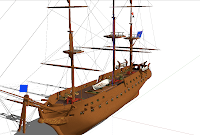
Ta-da! Not the best image quality compared to the amazing 3D work within the program. Additionally I uses many of the descriptions from the book to try and make it accurate.
Go try it!
In deciding what to do for this project, I wanted to try something challenging and something I'd never attempted before. Hence I stumbled upon Google SketchUp, the ultimate (at least for me) 3D modeling program. On the Google homepage, click on more then go to even more. You will find SketchUp under a list of tools/programs. Then you can download a free version and watch numerous tutorial videos on all the finer points. The basic premise of the program is to draw shapes and then pull them up into 3D. Originally designed for interior designers, architects, and engineers, it is fairly simple to use. You can create basic sketches of buildings and to get the "general idea" of something. Or you can make elaborate crazy designs. Click here to check out their amazing gallery. I set out to build a ship, not by divine command, but by my our initiative. I was able to find a preexisting model and work off of that. The only problem now is that as I try to upload the image of what I did, other formats are not meant for 3D or the .skp format. So I used previous tools such as screencast to capture an image of what I did.

Ta-da! Not the best image quality compared to the amazing 3D work within the program. Additionally I uses many of the descriptions from the book to try and make it accurate.
Go try it!
Monday, October 11, 2010
American Ideals vs. Perceptions
The mid 19th century found the fledgling American nation searching for an identity. Instead of being English, French, German, Dutch, Spanish, Irish, etc, the idea began to emerge that the people of the American continent were a completely new thing altogether. But what? Many suggested the beloved values of their mother countries, only for many philosophers to disregard the very thought. No way were we going to be a "hack" (to use our new lingo)- a clever imitation of something already done. No. We were the pioneers, the independents, the free-thinkers, the rebellious, and the mavericks. Tocqueville and many others set out to define the "American"- some through values and others through events/actions.
So what did they think was American?
- "Conquest"
- Discovery
- Individual development
- Freedom from government and social constraints
- Democracy
- Right to Rise
- Freedom of Speech and Religion
- Courage
- *Progress
Of their entire list, the word "progress" stood out to me. Though many things, ok- everything, has changed since the mid 19th century, change is constant. And I feel that America is a part of that. Now, I understand that we are not the center of most inventions or even all the best ideas. But there is a huge part of our culture that leads right into change; we strive for the next, better thing, the chance to revolutionize a field or market. As I was researching the American frontier and Manifest Destiny, I found it interesting to see how the perception of Americans abroad has also changed. In the beginning, many saw America as the upstart newbies. Who knows if they will last, but they have some great ideas and inexhaustable enthusiasm! Unfortunately, the majority opinion abroad today is very negative. I looked through European blogs and discussion boards and was saddened by the opinions and stereotypes that so many people have of America.
Here are just a few (the more articulate intelligent ones beyond hollywood and cheeseburgers).
So what did they think was American?
- "Conquest"
- Discovery
- Individual development
- Freedom from government and social constraints
- Democracy
- Right to Rise
- Freedom of Speech and Religion
- Courage
- *Progress
Of their entire list, the word "progress" stood out to me. Though many things, ok- everything, has changed since the mid 19th century, change is constant. And I feel that America is a part of that. Now, I understand that we are not the center of most inventions or even all the best ideas. But there is a huge part of our culture that leads right into change; we strive for the next, better thing, the chance to revolutionize a field or market. As I was researching the American frontier and Manifest Destiny, I found it interesting to see how the perception of Americans abroad has also changed. In the beginning, many saw America as the upstart newbies. Who knows if they will last, but they have some great ideas and inexhaustable enthusiasm! Unfortunately, the majority opinion abroad today is very negative. I looked through European blogs and discussion boards and was saddened by the opinions and stereotypes that so many people have of America.
Here are just a few (the more articulate intelligent ones beyond hollywood and cheeseburgers).
Subscribe to:
Posts (Atom)